Camilo
Rojas-Valdivia
Biology and Natural Sciences Educator
Training
I hold a Bachelor’s Degree in Biology and Natural Sciences Education from the Universidad de La Serena (2015–2019).My academic background has been enriched by a Diploma in Philosophy of Science with a specialization in Philosophy of Biology (Instituto de Filosofía y Ciencias de la Complejidad, 2020) and a Diploma in Board Game Creation for Learning (Academia Observatorio del Juego, 2021), reflecting my interest in both the theoretical foundations of science and innovative pedagogical tools.I am currently pursuing a Master’s in Didactics of Experimental Sciences at the Pontificia Universidad Católica de Valparaíso (2024–present), focusing on transforming science education through interdisciplinary, place-based, and emotionally engaging approaches.
Experience
My first years as a science teacher took place between Vicuña and La Serena, where I worked in secondary schools preparing students for the national university entrance exam (PSU).Later, I moved to Quellón, the southernmost city on Chiloé’s Isla Grande, where I guided school science projects that led several of my students to present at National Student Science Research Congresses. Some of them even achieved their first indexed publication while still in high school!During that time, I also led Bien-Austral, my first professional initiative focused on integrating environmental and emotional education through nature-based experiences in the classroom. This project earned me recognition as one of Chile’s 100 Young Leaders in 2023, helping to bring public attention to the importance of meaningful and responsible interactions with biodiversity and the environment.A few years ago, I moved to Valparaíso to pursue a Master's in Didactics of Experimental Sciences at the Pontificia Universidad Católica de Valparaíso. This decision was motivated by my desire to formalize and ground my professional experiences in theory, with the goal of identifying transferable elements that can contribute to science and environmental education more broadly.
Works
So far, most of my work has focused on presentations based on my professional experience and educational innovation, both in national media and at education-related conferences.However, one of my earliest projects dates back to 2018, when I collaborated with a team of psychologists—who also happened to be some of my best friends from school—as well as a chemistry teacher, who has since become one of my closest friends too! Together, we supported a teacher at a small rural multigrade school in implementing a Project-Based Learning experience. This was one of my first encounters with place-based education and hands-on work with the local environment. The entire process was documented in this booklet (in spanish), in case you’re curious to see how it all began!More recently, in a more formal and academic setting, my first paper on educational innovation was published, and I also contributed to a book chapter on another of my key interests: the use of technology in education.I am currently working on my Master's thesis, which explores how teachers' life experiences and professional trajectories relate to their nature relatedness and the ways they promote biophilia or biophobia in their classrooms.
Selected works
Connecting with the Territory to Connect with Oneself: An Experience Integrating Environmental and Emotional Education in Schools. Rojas-Valdivia, C. Presented at the V Conference of the Sociedad Chilena de Educación Científica, Puerto Montt, Chile, November 2023. Available in Spanish.
López-Cortés, F., Cortés, V., Carvajal, T., Bonilla, P., López, A., Órdenes, A., Rojas, C., Mossó, V., Valle, P., Cortés, M., Cortés, C., Pino, S. (2024). Teaching Biology with Digital Technologies: The Case of Augmented Reality. In Merino, C. (Ed.). Enseñanza y aprendizaje de las ciencias con tecnologías. Chile: Ediciones Universitarias de Valparaíso. Available in Spanish.
Rojas-Valdivia, C. (2023). Thermodynamically Open but Operationally Closed: A Proposal for Comprehensive Teaching of the Cell. Revista de Innovación en Enseñanza de las Ciencias, 5(2), 72-82. https://doi.org/10.5027/reinnec.V5.I2.126. Available in Spanish.
About me
Throughout my life, I have lived in various parts of Chile: Vicuña, La Serena, Quellón, and, more recently, Valparaíso. Constantly moving between the transverse valleys of the semi-arid north, the southern archipelagos, and the sclerophyllous forests of central Chile—and having worked in all these places as a science teacher and amateur nature photographer—my interest turned toward understanding how people shape their relationships with species and the environment.This interest is perhaps a natural consequence of my own story: my mother is a teacher who spent many years working in early childhood education and later in school counseling and coexistence programs; my father is an agricultural engineer with a fascination for fermented beverages as a cultural phenomenon. In a way, I find myself somewhere in between the two!Today, as a science educator, I try to weave these personal and geographical roots into my teaching practice, fostering experiences that connect students emotionally and intellectually with the ecosystems they inhabit. I believe that teaching science is not only about delivering content, but also about opening up spaces for people to reimagine their relationships with nature—nurturing a sensitivity that blends wonder, critical thinking, and commitment to the world we share.
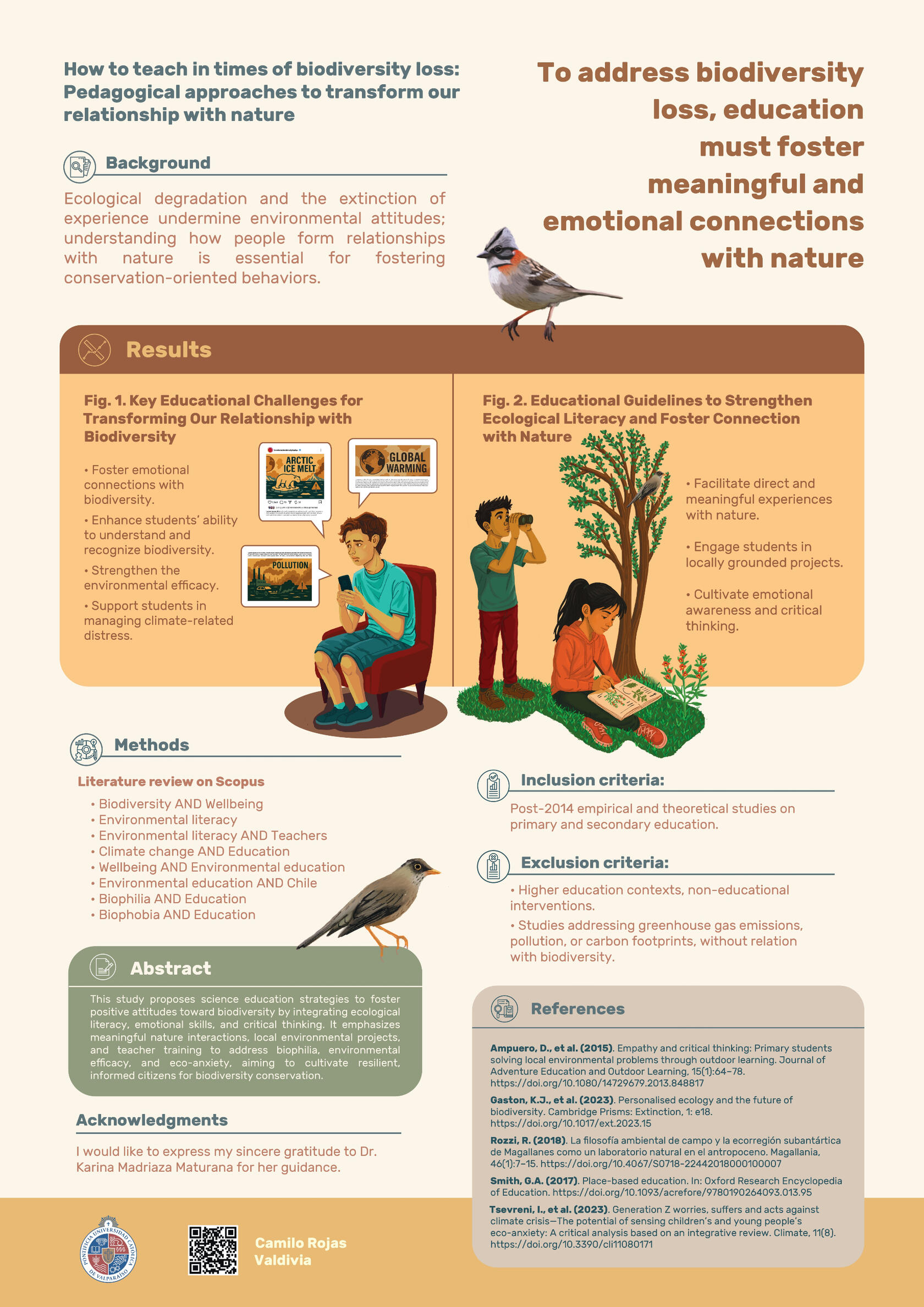
How to teach in times of biodiversity loss: Pedagogical approaches to transform our relationship with nature
ABSTRACTBiodiversity loss, exacerbated by climate change, represents a critical challenge that demands an integrated educational response. This article presents a narrative review exploring pedagogical approaches aimed at improving students' attitudes towards biodiversity and fostering pro-environmental behaviors. Recent literature identifies four main educational challenges: promoting positive attitudes towards biodiversity, increasing environmental literacy, fostering environmental efficacy, and reducing maladaptation due to climate anxiety. In response, three key pedagogical approaches are proposed: place-based education (PBL), Field Environmental Philosophy (FILAC), and the development of personalized ecologies. These strategies, including field trips, nature journaling, and the creation of gardens and green spaces, are highlighted for their ability to connect students with nature while fostering socioemotional and critical thinking skills. However, their implementation faces barriers such as limited time, resources, and adequate teacher training. It is concluded that integrating these approaches into school curricula can help build a citizenship committed to sustainability and environmental regeneration, especially if supported by teacher professional development programs that enhance their application across diverse educational contexts.
Context and Relevance to Science EducationThe alterations in ecosystems, driven largely by human activities, have profound implications for ecological stability and functioning. For instance, forest fragmentation decreases species richness, simplifies trophic chains, and disrupts nutrient cycling, while pesticide use affects pollination and pest control, impacting ecosystem resilience (Haddad et al., 2015; Sánchez-Bayo & Wyckhuys, 2019). These effects intensify with climate change, further altering population dynamics, ecological interactions, and habitat fragmentation (IPBES, 2019).In this context, understanding how people form relationships with nature is crucial for fostering conservation-oriented behaviors. Phenomena such as the shifting baseline syndrome—the tendency to perceive current degraded states as “normal”—and the extinction of experience—a decline in meaningful interactions with nature—negatively impact environmental attitudes and behaviors (Soga & Gaston, 2018). Positive relationships, mediated by biophilia (affinity for life) and biophobia (negative emotions towards nature), play a vital role in shaping pro-environmental actions (Gaston & Soga, 2020). In light of these challenges, education emerges as a powerful tool to cultivate emotional and cognitive connections to biodiversity.This study explores how to promote positive attitudes and relationships towards biodiversity, especially in the context of the pressing global challenges of biodiversity loss and climate change. The goal is to integrate ecological literacy, emotional well-being, and proactive attitudes towards conservation into science education.
Aims of StudyThe study aims to:
Synthesize evidence on the formation of environmental attitudes and behaviors.
Synthesize the evidence on pedagogical approaches that promote positive relationships with biodiversity.
Propose evidence-based guidelines for designing impactful science education practices.
METHODSA literature review was conducted using Scopus, focusing on:
Biodiversity, well-being, and human development.
Educational strategies addressing biodiversity loss and emotional well-being.
The intersection of environmental education and socio-emotional development.
Inclusion criteria emphasized recent (post-2014) empirical and theoretical studies relevant to primary and secondary education. Exclusions included higher education contexts, non-educational interventions, and studies addressing aspects of the climate crisis such as greenhouse gas emissions, pollution, or carbon footprints, without directly considering biodiversity.Search terms included combinations such as:
Biodiversity AND Wellbeing
Environmental literacy
Environmental literacy AND Teachers
Climate change AND Education
Wellbeing AND Environmental education
Environmental education AND Chile
Biophilia AND Education
Biophobia AND Education
Emerging themes guided additional searches to refine the conceptual and practical recommendations.
RESULTSRelationships with NaturePersonalised ecologies—defined as sensory interactions with diverse ecosystems—serve as a framework to understand how direct experiences shape environmental attitudes (Gaston et al., 2023). Positive interactions, such as observing natural processes or cultivating plants, foster biophilia, while negative experiences can amplify biophobia (Gaston et al., 2023; Gong & Li, 2024). Educational strategies, including species identification and sensory exploration, enhance these interactions, increasing pro-environmental behaviors and ecological literacy.Climate anxiety and eco-anxietyClimate and eco-anxiety are prevalent among younger generations, influencing their engagement with environmental issues (Tsevreni et al., 2023). While such emotions can drive action when paired with a sense of environmental efficacy, they also highlight the importance of emotional education to mitigate distress and foster resilience (Becht et al., 2024). Furthermore, differences in emotional education have been found to contribute to varying responses to climate anxiety based on gender, with men reportedly having fewer resources to cope with it (Wullenkord et al., 2024).Educational StrategiesPlace-based education (PBL) is an educational approach that seeks to integrate education, environmental protection, and community development by using local issues and contexts as a foundation for school learning (Smith, 2017). Strategies include school projects, field trips, scientific camps, and nature journaling (Bollich, 2023). Evidence shows that this approach improves learning outcomes, particularly when students have autonomy over their education and perceive that their work contributes to the environment. However, it faces obstacles such as lack of time, funding, and teacher training (Hamilton & Marckini-Polk, 2023).Another approach is 'playscapes,' which are spaces designed to encourage exploration and sensory play, recreating natural landscapes with both natural and artificial movable elements. This type of play, especially exploratory play, promotes intrinsically motivated inquiry, the development of environmentally responsible behaviors, and fosters creativity and emotional connection to the environment (Loebach & Cox, 2022; Wight et al., 2016; Yuan et al., 2024).In Chile, the use of, student-managed school gardens, has shown that integrating emotional skills and critical thinking promotes pro-environmental behaviors and dispositions such as self-confidence and open-mindedness (Ampuero et al., 2015). Likewise, Field Environmental Philosophy (FILAC), which uses ecological and philosophical knowledge, promotes activities such as contemplative pauses, sensory exploration, and school science projects related to ecosystems (Rozzi, 2018; Lewis et al., 2018; Rendoll-Cárcamo et al., 2020).Educational Guidelines to Promote Positive Attitudes and Relationships Toward BiodiversityBased on the reviewed literature on the formation of attitudes and relationships with nature, as well as the challenges that biodiversity loss poses for society in general and the educational system in particular, we can establish that education faces the following challenges:
Enriching personalized ecologies by fostering biophilia and mitigating biophobia, understanding them as positive and negative emotions and attitudes toward biodiversity and living beings, respectively
Increasing environmental literacy and, therefore, individuals' capacity to recognize both the different components of biodiversity and the potential threats it faces.
Promoting environmental efficacy, that is, the belief that individual and collective actions have a significant impact on mitigating climate change.
Reducing the likelihood of maladaptation due to climate anxiety and eco-anxiety through emotional management skills.
Based on the reviewed evidence, we propose that education aimed at promoting positive attitudes and relationships toward biodiversity should follow three guidelines to guide educational practices:
Create opportunities for meaningful interaction with nature, both inside and outside the classroom.
Promote positive impacts on the immediate local environment through projects that connect students with their context.
Develop emotional and critical thinking skills that enable students to face environmental and emotional challenges.
DISCUSSIONBiodiversity loss and climate change demand educational responses that foster an environmentally respectful society. Incorporating the concept of personalized ecologies in education implies recognizing that people's interactions with their natural environment vary among individuals and groups, which is essential for building meaningful relationships with nature. This approach aligns with the objectives of the Natural Sciences curriculum, which aims not only to provide knowledge about biodiversity but also to nurture curiosity about the natural world (MINEDUC, 2024). Rich personalized ecologies are associated with greater environmental literacy and pro-environmental behaviors (Gaston et al., 2023).Approaches such as place-based education (PBL) and Field Environmental Philosophy (FILAC) promote direct interaction with the environment, contributing to the development of enriched personalized ecologies. Teachers in Chile have highlighted the need to incorporate outdoor spaces and collaborative approaches that involve communities (Prosser-Bravo et al., 2022). Field trips and nature journaling are flexible tools that can foster students' connection with their environment, strengthening their positive emotions and socio-emotional skills (Tsevreni, 2021).However, the implementation of these approaches faces challenges in the Chilean educational context, such as a lack of time, resources, and support from the school community (Prosser-Bravo et al., 2020). While these practices can be integrated into the regular curriculum, their success depends on the active commitment of the entire school community.The development of spaces such as gardens, orchards, and green roofs also contributes to fostering pro-environmental attitudes and socio-emotional skills. Although they require time, these processes align with the Cross-cutting Learning Objectives of the current curriculum (MINEDUC, 2016, 2018), and support emotional development, which is crucial for addressing climate anxiety.Finally, teacher training is a key factor. Many teachers in Chile are not sufficiently trained in environmental education, which limits their ability to integrate these approaches into the classroom (Torres-Rivera et al., 2017; Karelovic-Vargas & Kong, 2022). It is essential that teacher training includes these methodologies to ensure the success of environmental education (Gong & Li, 2024).
CONCLUSIONEducation is at a crucial moment to address environmental challenges, such as biodiversity loss and its effects on human well-being. This work identifies four key challenges: fostering positive relationships and emotions toward biodiversity, increasing environmental literacy, promoting environmental efficacy, and reducing eco-anxiety. Three guidelines are proposed to address these challenges: creating meaningful interactions with nature, generating positive impacts on the environment, and developing emotional and critical thinking skills. Place-based education and Field Environmental Philosophy approaches, along with strategies such as field trips, nature journalings, and the creation of green spaces, are presented as effective tools. However, it is crucial to overcome obstacles such as lack of time, resources, and community support, as well as to have trained teachers, to achieve an education that shapes citizens committed to the conservation and regeneration of the environment.
REFERENCES
Albuquerque, U. P., & Silva, J. V. M. (2024). Why do we love pandas and hate cockroaches? Ethnobiology and Conservation, 13, 1-7. Scopus. https://doi.org/10.15451/ec2024-07-13.22-1-7
Ampuero, D., Miranda, C. E., Delgado, L. E., Goyen, S., & Weaver, S. (2015). Empathy and critical thinking: Primary students solving local environmental problems through outdoor learning. Journal of Adventure Education and Outdoor Learning, 15(1), 64-78. Scopus. https://doi.org/10.1080/14729679.2013.848817
Becht, A., Spitzer, J., Grapsas, S., van de Wetering, J., Poorthuis, A., Smeekes, A., & Thomaes, S. (2024). Feeling anxious and being engaged in a warming world: Climate anxiety and adolescents’ pro-environmental behavior. Journal of Child Psychology and Psychiatry and Allied Disciplines. Scopus. https://doi.org/10.1111/jcpp.14035
Bertling (2019). Non-place and the future of place-based education. Environmental Education Research. https://doi.org/10.1080/13504622.2018.1558439
Bollich, J. (2023). Nature Journaling in the High School Classroom. American Biology Teacher, 85(4), 187-191. Scopus. https://doi.org/10.1525/abt.2023.85.4.187
Dirzo, R., Young, H. S., Galetti, M., Ceballos, G., Isaac, N. J. B., & Collen, B. (2014). Defaunation in the Anthropocene. Science (New York, N.Y.), 345(6195), 401-406. https://doi.org/10.1126/science.1251817
Carr, V., & Luken, E. (2014). Playscapes: A pedagogical paradigm for play and learning. International Journal of Play, 3(1), 69-83. Scopus. https://doi.org/10.1080/21594937.2013.871965
Common Worlds Research Collective. (2020). Learning to become with the world: Education for future survival. Education Research and Foresight Working Paper 28. Paris, UNESCO
Crandon, T. J., Scott, J. G., Charlson, F. J., & Thomas, H. J. (2024). A theoretical model of climate anxiety and coping. Discover Psychology, 4(1). Scopus. https://doi.org/10.1007/s44202-024-00212-8
Colléony, A., Cohen-Seffer, R., & Shwartz, A. (2020). Unpacking the causes and consequences of the extinction of experience. Biological Conservation, 251. Scopus. https://doi.org/10.1016/j.biocon.2020.108788
Curll, S. L., Stanley, S. K., Brown, P. M., & O’Brien, L. V. (2022). Nature Connectedness in the Climate Change Context: Implications for Climate Action and Mental Health. Translational Issues in Psychological Science, 8(4), 448-460. Scopus. https://doi.org/10.1037/tps0000329
Deutsch, C., Grisolia, J., Bilenca, D., & Agostini, M. G. (2021). Human attitudes as threats in amphibians: The case of the Ornate Horned Frog (Ceratophrys ornata). Human Dimensions of Wildlife, 26(3), 210-227. https://doi.org/10.1080/10871209.2020.1808122
Guerrero, G. R., & Torres-Olave, B. (2021). Scientific literacy and agency within the Chilean science curriculum: A critical discourse analysis. The Curriculum Journal, 33(3), 0-17. https://doi.org/10.1002/curj.141
Gong, C., & Li, S. (2024). Environment or behavior: Which childhood nature experiences predict nature relatedness in early adulthood? Landscape and Urban Planning, 252. Scopus. https://doi.org/10.1016/j.landurbplan.2024.105176
Gaston, K. J. (2024). Characterizing personalized ecologies. Journal of Zoology, 322(4), 291-308. Scopus. https://doi.org/10.1111/jzo.13158
Gaston, K. J., Phillips, B. B., & Soga, M. (2023). Personalised ecology and the future of biodiversity. Cambridge Prisms: Extinction, 1, e18. https://doi.org/10.1017/ext.2023.15
Gaston, K. J., Soga, M., Duffy, J. P., Garrett, J. K., Gaston, S., & Cox, D. T. C. (2018). Personalised Ecology. Trends in Ecology & Evolution, 33(12), 916. https://doi.org/10.1016/j.tree.2018.09.012
Gaston, K. J., & Soga, M. (2020). Extinction of experience: The need to be more specific. People and Nature, 2(3), 575-581. Scopus. https://doi.org/10.1002/pan3.10118
Haddad, N. M., Brudvig, L. A., Clobert, J., Davies, K. F., Gonzalez, A., Holt, R. D., Lovejoy, T. E., Sexton, J. O., Austin, M. P., Collins, C. D., Cook, W. M., Damschen, E. I., Ewers, R. M., Foster, B. L., Jenkins, C. N., King, A. J., Laurance, W. F., Levey, D. J., Margules, C. R., … Townshend, J. R. (2015). Habitat fragmentation and its lasting impact on Earth’s ecosystems. Science Advances, 1(2), e1500052. https://doi.org/10.1126/sciadv.1500052
Hamilton, E., & Marckini-Polk, L. (2023). The impact of place-based education on middle school students’ environmental literacy and stewardship. Cogent Education, 10(1). Scopus. https://doi.org/10.1080/2331186X.2022.2163789
IPBES. (2019). Global assessment report on biodiversity and ecosystem services of the Intergovernmental Science‐Policy Platform on Biodiversity and Ecosystem Services. (Version 1). Zenodo. 2019. p.1148. https://doi.org/10.5281/ZENODO.3831673
Karelovic-Vargas, F. & Kong, F. (2022). Articulación entre educación ambiental y educación científica: Una mirada desde las competencias en sostenibilidad desarrolladas en la formación inicial docente. Pensamiento Educativo: Revista de Investigación Educacional Latinoamericana, 59(1), 1-18. https://doi.org/10.7764/PEL.59.1.2022.8
Lewis, L., Gottschalk-Druschke, C., Saldías, C., Mackenzie, R., Malebrán, J., Goffinet, B., Rozzi, R., Lewis, L., Gottschalk-Druschke, C., Saldías, C., Mackenzie, R., Malebrán, J., Goffinet, B., & Rozzi, R. (2018). Cultivando un jardín de nombres en los bosques en miniatura del cabo de hornos: Extensión de la conservación biocultural y la ética a seres vivos poco percibidos. Magallania (Punta Arenas), 46(1), 103-123. https://doi.org/10.4067/S0718-22442018000100103
Loebach, J., & Cox, A. (2022). Playing in ‘The Backyard’: Environmental Features and Conditions of a Natural Playspace Which Support Diverse Outdoor Play Activities among Younger Children. International Journal of Environmental Research and Public Health, 19(19). Scopus. https://doi.org/10.3390/ijerph191912661
Mackay, C. M. L., & Schmitt, M. T. (2019). Do people who feel connected to nature do more to protect it? A meta-analysis. Journal of Environmental Psychology, 65, 101323. https://doi.org/10.1016/j.jenvp.2019.101323
Ministerio de Educación. (2016). Bases Curriculares 7° básico a 2° medio. https://www.curriculumnacional.cl/614/articles-37136_bases.pdf
Ministerio de Educación. (2018). Bases Curriculares Primero a Sexto Básico. https://www.curriculumnacional.cl/614/articles-22394_bases.pdf
Ministerio de Educación. (2019). Bases Curriculares 3° y 4° Medio. https://www.curriculumnacional.cl/614/articles-91414_bases.pdf
Ministerio de Educación. (2024). Bases Curriculares 1° Básico a 2° Medio. Propuesta de actualización para consulta pública 2024. https://www.curriculumnacional.cl/614/articles-351761recurso02.pdf
Muñoz-Pedreros, A. (2014). La educación ambiental en Chile, una tarea aún pendiente. Ambiente & Sociedade, 17(3). https://doi.org/10.1590/S1414-753X2014000300011
Prosser-Bravo, G., Bonilla, N., Pérez-Lienqueo, M., Prosser-González, C. M., & Rojas-Andrade, R. M. (2020). No basta con la semilla, se ha de acompañar al árbol: Importancia del contexto de implementación en los programas de educación ambiental. Revista Colombiana de Educacion, 1(78), 73-96. Scopus. https://doi.org/10.17227/rce.num78-9322
Prosser-Bravo, G., Bonilla, N., Prosser-González, C., Romo-Medina, I., (2022). Expertos por experiencia en la educación para el cambio climático: Emociones, acciones y estrategias desde la perspectiva de participantes de tres programas escolares chilenos. Revista de estudios y experiencias en educación, 21(45), 232-251. https://doi.org/10.21703/0718-5162.v21.n45.2022.012
Quiroz-Martinez, D. (2024). Chemistry teachers’ perspectives and understanding in integrating sustainability into teaching: The case of Chile. Environmental Education Research, 30(3), 432-449. https://doi.org/10.1080/13504622.2023.2193688
Rendoll Cárcamo, J., Contador, T., Gañán, M., Houston, N., Troncoso, M., Arriagada, G., Saldías, C., Caballero, P., Malebrán, J., Kennedy, J., Convey, P., Rozzi, R., Rendoll Cárcamo, J., Contador, T., Gañán, M., Houston, N., Troncoso, M., Arriagada, G., Saldías, C., Caballero, P., Malebrán, J., Kennedy, K., Convey, P. & Rozzi, R. (2020). Filosofía ambiental de campo: Educación e investigación para la valoración ecológica y ética de los insectos dulceacuícolas. Magallania (Punta Arenas), 48(2), 213-228. https://doi.org/10.4067/S0718-22442020000200213
Rozzi, R. (2018). La filosofía ambiental de campo y la ecorregión subantártica de magallanes como un laboratorio natural en el antropoceno. Magallania (Punta Arenas), 46(1), 7-15. https://doi.org/10.4067/S0718-22442018000100007
Sánchez-Bayo, F., & Wyckhuys, K. A. G. (2019). Worldwide decline of the entomofauna: A review of its drivers. Biological Conservation, 232, 8-27. https://doi.org/10.1016/j.biocon.2019.01.020
Smith, G. A. (2017). Place-Based Education. En Oxford Research Encyclopedia of Education. https://doi.org/10.1093/acrefore/9780190264093.013.95
Soga, M., & Evans, M. J. (2024). Biophobia: What it is, how it works and why it matters. People and Nature, 6(3), 922-931. Scopus. https://doi.org/10.1002/pan3.10647
Soga, M., Evans, M. J., Yamanoi, T., Fukano, Y., Tsuchiya, K., Koyanagi, T. F., & Kanai, T. (2020). How can we mitigate against increasing biophobia among children during the extinction of experience? Biological Conservation, 242, 108420. https://doi.org/10.1016/j.biocon.2020.108420
Soga, M., & Gaston, K. J. (2018). Shifting baseline syndrome: Causes, consequences, and implications. Frontiers in Ecology and the Environment, 16(4), 222-230. https://doi.org/10.1002/fee.1794
Soga, M., Gaston, K. J., Fukano, Y., & Evans, M. J. (2023). The vicious cycle of biophobia. Trends in Ecology and Evolution, 38(6), 512-520. Scopus. https://doi.org/10.1016/j.tree.2022.12.012
Suarez, D. C., Kircher, C., & Santi, T. (2024). A Clear and Present Pedagogy: Teaching About Planetary Crisis (When You’re in a Planetary Crisis). Antipode, 56(1), 276-298. Scopus. https://doi.org/10.1111/anti.12977
Torres-Rivera, L. B., Benavides-Peña, J. E., Latoja-Vollouta, C. J., & Novoa-Contreras, E. R. (2017). Presencia de una Educación Ambiental basada en conocimiento, actitudes y prácticas en la enseñanza de las ciencias naturales en establecimientos municipales de la ciudad de Los Ángeles, Chile. Estudios pedagógicos (Valdivia), 43(3), 311-323. https://doi.org/10.4067/S0718-07052017000300018
Tsevreni, I. (2021). Nature journaling as a holistic pedagogical experience with the more-than-human world. Journal of Environmental Education, 52(1), 14-24. Scopus. https://doi.org/10.1080/00958964.2020.1724854
Tsevreni, I., Proutsos, N., Tsevreni, M., & Tigkas, D. (2023). Generation Z Worries, Suffers and Acts against Climate Crisis—The Potential of Sensing Children’s and Young People’s Eco-Anxiety: A Critical Analysis Based on an Integrative Review. Climate, 11(8). Scopus. https://doi.org/10.3390/cli11080171
Wight, R. A., Kloos, H., Maltbie, C. V., & Carr, V. W. (2016). Can playscapes promote early childhood inquiry towards environmentally responsible behaviors? An exploratory study. Environmental Education Research, 22(4), 518-537. Scopus. https://doi.org/10.1080/13504622.2015.1015495
Woods, V., & Knuth, M. (2023). The Biophilia Reactivity Hypothesis: Biophilia as a temperament trait, or more precisely, a domain specific attraction to biodiversity. Journal of Bioeconomics, 25(3), 271-293. Scopus. https://doi.org/10.1007/s10818-023-09342-w
Wullenkord, M. C., Johansson, M., Loy, L. S., Menzel, C. & Reese, G. (2024). Go out or stress out? Exploring nature connectedness and cumulative stressors as resilience and vulnerability factors in different manifestations of climate anxiety. Journal of Environmental Psychology, 95. Scopus. https://doi.org/10.1016/j.jenvp.2024.102278
Yemini, M., Engel, L., & Ben Simon, A. (2023). Place-based education–a systematic review of literature. Educational Review. Scopus. https://doi.org/10.1080/00131911.2023.2177260
Yuan, Y., Zeng, W., Kloos, H., Brown, R., & Carr, V. (2024). Preschool Engineering Play on Nature Playscapes. Early Childhood Education Journal. Scopus. https://doi.org/10.1007/s10643-024-01743-4
Zsido, A. N., Coelho, C. M., & Polák, J. (2022). Nature relatedness: A protective factor for snake and spider fears and phobias. People and Nature, 4(3), 669-682. Scopus. https://doi.org/10.1002/pan3.10303
This proposal was accepted for presentation as a poster at the 16th ESERA Conference, following review by the event’s academic committee.However, it has not undergone peer review within the context of a formal scientific publication.This document may not be reproduced, distributed, or cited without the express permission of the author.